Outside city limits, wastewater is your responsibility — and Denton County's clay-heavy soil means most new builds need more than a basic tank-and-field setup.
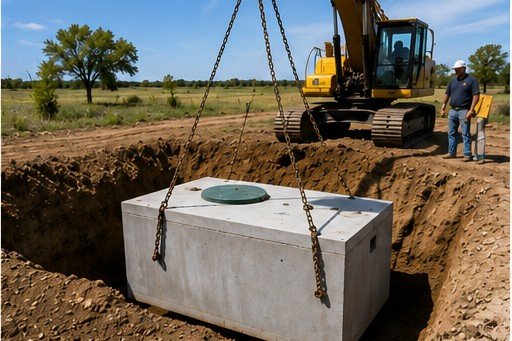
Any property outside city limits in Denton County needs an On-Site Sewage Facility (OSSF) permit before a septic system goes in. Denton County Public Health handles this as a TCEQ Authorized Agent, meaning the permit is processed locally rather than through a regional TCEQ office — that generally means a faster process than in counties without local authorization.
Before any design work happens, a licensed site evaluator tests your soil — depth to water table, absorption rate, and soil texture — because Denton's mix of Blackland Prairie clay in the east and Cross Timbers sandy loam in the west behaves very differently underground. Clay-heavy sites often can't support a simple gravity-fed system and need an aerobic treatment unit instead, which uses a small pump and aerator to treat wastewater before it's dispersed.
| System type | Best suited for | Typical cost |
|---|---|---|
| Conventional gravity | Sandy, well-draining soil | $6,000 – $10,000 |
| Aerobic treatment unit | Clay-heavy or tight lots | $9,000 – $15,000 |
Ranges reflect general North Texas contractor pricing as of 2026, based on typical residential installs; your site evaluation determines which system fits your lot and gets you an exact quote.
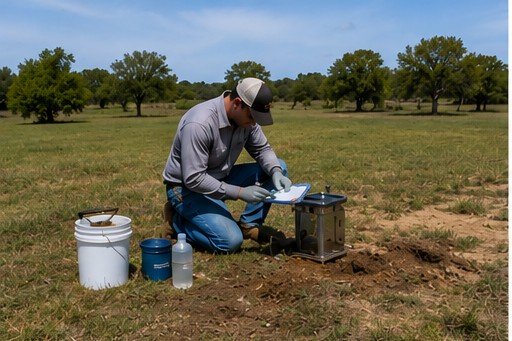
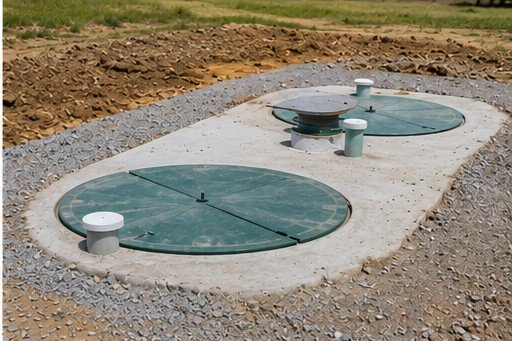
Site evaluation, permit review, and installation typically run several weeks total, depending on county permit volume — new-construction season can add to the queue, so it's worth starting early.
Clay soil drains slowly, so a standard gravity drain field can fail or back up. An aerobic system actively treats wastewater before dispersal, which works even where the soil doesn't drain well on its own.
Budgeting for a conventional system before the soil test comes back. If your lot needs aerobic, the cost is meaningfully higher — better to know early in your build budget than mid-project.
